
Discover Timeless Artistry
Explore a curated collection that reflects elegance and sophistication. Our gallery features exquisite pieces that resonate with authenticity and character. Each artwork is chosen to inspire connection and admiration, inviting you to experience art in its finest form.
Gallery
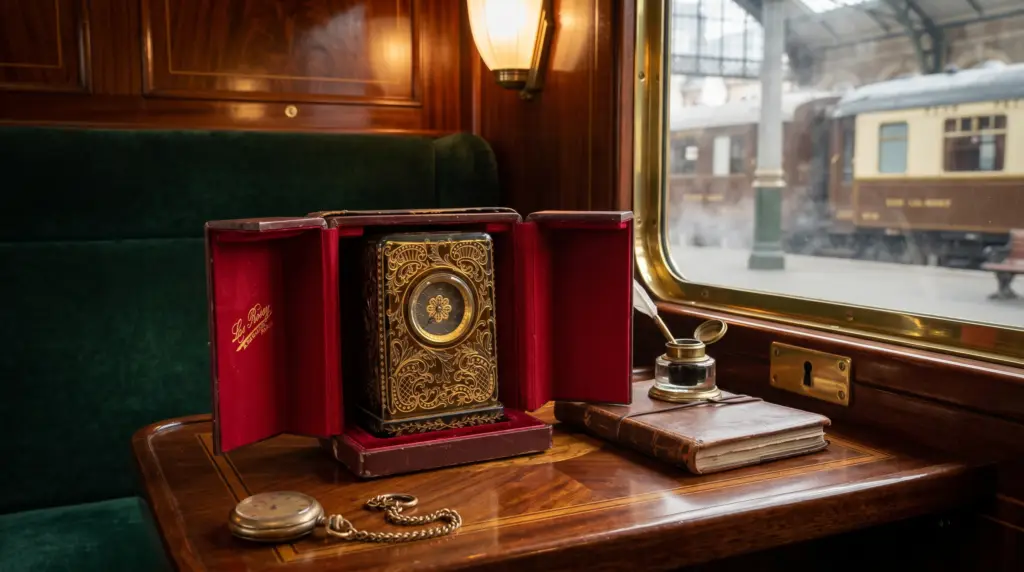
Condition: Movement running; glass body intact; minor chip to rear left corner of base; gilding with expected light wear; case with surface wear consistent with age.
Literature: Allix & Bonnert, Carriage Clocks: Their History and Development, Antique Collectors' Club, 1974 Roberts, Derek, Carriage and Other Travelling Clocks, Schiffer, 1993 Tardy, Dictionnaire des Horlogers Français, Paris, 1971 Mergl & Pánkova, Moser Karlsbad (catalogue raisonné), for Bohemian amber glass attribution Marks on China database: Lerosey, Rue de la Paix, documents Le Rosey at multiple addresses along the Rue de la Paix from circa 1880.
Price: 4850 Euro
Carriage Clock in Amber Crystal with Case
A rare and exquisite carriage clock, the entire body formed from richly tinted amber (topaz) crystal glass, profusely decorated on all four sides and the top with finely wheelengraved and gilt scrolling acanthus foliage, shell and fan cartouches, bead borders, and foliate sprays in the Rococo Revival taste. The clock sits on a stepped rectangular base with engraved laurel border, raised on four small gilt brass bun feet. The front face is centred with a circular gilt brass bezel enclosing a dark dial with elegant blued steel hands, the hour hand centred on a pierced gilt rosette of fine filigree work. The rear carries the most elaborate engraving, a large guilloché crosshatch cartouche framed by bold C-scroll volutes and radiating fan ornament. The movement is a compact cylinder escapement platform, serial no. 9691, in running order and showing pleasing unrestored patination. The piece bears a double signature: engraved directly into the glass on the underside of the base “Le Rosey à Paris” and giltstamped to the interior of the original fitted case,”Le Rosey / 8 Rue de la Paix / Paris”. Le Rosey was among the most prestigious luxury retailers of the Belle Époque, operating on the Rue de la Paix, the most exclusive shopping street in Paris, home to Cartier and the great jewellery houses. Retains its original double-door presentation case in burgundy leather with wire handle and brass hasp, crimson silk velvet interior.
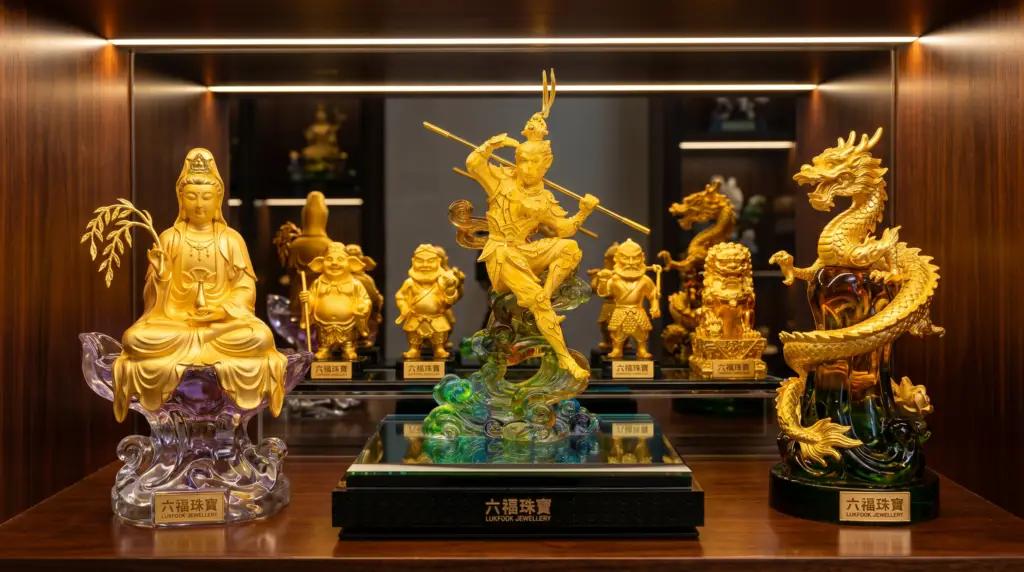
Technique: Pure gold (999.9) electroforming — a prestigious goldsmithing method in which fine gold is electrolytically deposited over a sculpted form, achieving extraordinary threedimensional detail at large scale.
Gold weight: 94 grams (999.9 / 24 karat). Lukfook ref. D2649. Dimensions: Figure approx. 30 cm height. Display case 43 × 28 × 22 cm.
Provenance: Corporate presentation piece gifted to the Baique Ling Group (百雀羚集團), Shanghai — one of China's oldest and most distinguished personal care corporations, founded 1931 — on 23 February 2016, during the Chinese New Year of the Monkey celebrations. The engraved dedication on the display case constitutes a rare and fully documented corporate provenance.
Condition: Excellent throughout. Gold figure bright and undamaged. Liuli base intact. Original display case present.
Price on request.
"MONKEY KING" (猴王) PURE GOLD FIGURINE, LUKFOOK JEWELLERY, HONG KONG, 2016
A magnificent pure gold electroformed figure of Sun Wukong, the Monkey King, hero of the classic Chinese literary epic Journey to the West (西遊記). Depicted in full battle armour in a powerful warrior pose, wielding his legendary Ruyi Jingu Bang (如意金箍棒 the magical expanding staff), striding atop swirling auspicious clouds. The figure is set on a polychrome liuli (琉璃) art glass base in the form of clouds above the Flower-Fruit Mountain, in graduated amber, apple green and teal tones. Mounted on a black lacquered plinth with green mirror glass insert, bearing the maker’s mark 六福珠寶 / LUKFOOK JEWELLERY in gilt. Housed in its original acrylic display case, engraved in gilt Chinese characters: 中國上海百雀羚集團 (China Shanghai Baique Ling Group) / 李強贈 2016年2月23日 (Gift from Li Qiang, 23 February 2016).
No founder's stamp is present. Common for high-quality workshop bronzes of the 18th century. Comparable models are attributed to the circle of Parisian sculptor and bronzier Jean-Louis Prieur the Elder (1732–1795); a related example is held at the Petit Trianon, Versailles.
Price: 8500 Euro
A pair of French Louis XVI Chenets with Veiled Putti
A very fine pair of French figural chenets (fireplace andirons) in patinated and gilt bronze. Each chenet is surmounted by a seated putto playfully hiding beneath a large, draped veil. A charming cache-cache (peek-a-boo) motif characteristic of French decorative arts in the late Ancien Régime period.
The figures are of exceptional quality, finely chased with expressive faces and beautifully rendered drapery. They rest on elegant Louis XVI-style ormolu bases decorated with laurel garland friezes, beaded borders, fluted pilasters, oval cartouches, and turned bun feet. The hollow-cast construction with iron armature is consistent with authentic Parisian bronze foundry work of the period.
Paris date circa 1775-1780.
Dimensions: H. 95 cm — W. 87 cm — D. 56 cm
Literature: D. Ledoux-Lebard, Le mobilier français du XIXe siècle, Paris 1989/2000, pp. 267–350; C. Mestdagh & P. Lécoules, L'Ameublement d'Art Français 1850–1900, Paris 2010, pp. 296–299.
Price : 4500 Euro
An elegant two-tier tea table in mahogany with gilt bronze figures circa 1870
An elegant two-tier tea table in mahogany with richly chased gilt bronze mounts.
The rectangular upper tier with rounded canted corners is framed by a gilt bronze gallery rail and supported by four freestanding gilt bronze caryatid figures of classical standing females in antique dress, arms raised, standing upon the lower tier. The lower tier of conforming form rests on an apron mounted with a continuous laurel leaf swag suspended from rosette paterae, with six-pointed star mounts at the angles. The four circular tapered legs are mounted with foliate capital collars and terminate in acanthus leaf sabots on casters. The quality of casting and the overall decorative programme are characteristic of the finest Parisian ébénisterie of the second half of the 19th century, in the manner of Sormani and the circle of Linke.
The figural type of standing caryatids bearing a tier derives from the Empire period prototype executed by Jacob-Desmalter in 1808 for the bedroom of Caroline Murat at the Élysée Palace, subsequently transferred to the Grand Trianon where it remains today.
Condition: Excellent. The case professionally cleaned, the original mercury gilding preserved throughout with a fine rose gold tone.
Jean-André Reiche (1752 Steinbach, Saxony – 1817 Paris) ranks among the foremost bronziers of the Consulate and Empire. Established in Paris from 1785, he ran a substantial workshop first in the rue Vieille-du-Temple, later in the rue des Trois Bornes, supplying gilt bronze clock cases and mounts to the leading horlogers of the period including Lepaute, Bréguet and Le Roy. His surviving livres de modèles, preserved in the Bibliothèque des Arts Décoratifs in Paris, record an extensive allegorical and mythological repertoire from which this composition derives. Examples by Reiche are held in the Mobilier National, the Château de Fontainebleau, and the Residenz München.
Literature:
Elke Niehüser, French Bronze Clocks 1700–1830, Schiffer Publishing, Atglen 1999. Pierre Kjellberg, La Pendule française du Moyen Âge au XXe siècle, Les Éditions de l'Amateur, Paris 1997.
Hans Ottomeyer / Peter Pröschel, Vergoldete Bronzen. Die Bronzearbeiten des Spätbarock und Klassizismus, Klinkhardt & Biermann, Munich 1986. Tardy, La Pendule française, Paris. Jean-Dominique Augarde, Les Ouvriers du Temps. La pendule à Paris de Louis XIV à Napoléon Ier, Antiquorum Editions, Geneva 1996.
Price : 4500 Euro
Empire Gilt Bronze Mantel Clock, "Allegory of Summer"
Finely chased bronze, mercury gilt with a warm rose gold tone. The dial with white enamel chapter ring, Roman numerals for the hours and outer Arabic minute track, blued steel Breguet hands, set within a guilloché gilt centre and inserted into a great bound sheaf of wheat that conceals the movement. To the left stands the goddess Ceres, allegory of Summer, draped à l’antique and crowned with wheat ears, raising in her right hand a crescent sickle. To the right, a round wicker winnowing basket (van) set against a threshing flail, emblems of the summer harvest.
Stepped rectangular plinth, the central panel with a fine bas relief of a peasant ploughing with a pair of oxen drawing an araire, flanked on either projecting block by laurel wreaths crossed with rake and spade. Raised on six turned bun feet.
Countwheel movement, silk thread suspension, striking the hours and half hours on a bell. With key.
A very similar pair is preserved in the collections of the Palazzo Pitti, Florence.
Provenance: Koller Auktionen, Zurich, lot 1717.
Literature: A. d'Agliano, Ceramiche dell'Ottocento, Novara 1985, p. 61.
France, attributed to the Manufacture de Bayeux, circa 1850.
Dimensions: H. 78 cm, W. 33.5 cm.
Condition: Good overall, with a chip to one of the flared rim extensions, as catalogued at Koller.
Price : 3500 Euro
Large Pair of Vieux Paris Porcelain Vases
Large Pair of Vieux Paris Porcelain Vases, attributed to the Manufacture de Bayeux, Napoleon III, circa 1850
A fine and decorative pair of large porcelain baluster vases of Louis-Philippe / Napoleon III form, the flared leaf shaped rim, lateral foliate handles and shaped oval foot richly modelled in relief and accented with burnished mercury gilding. Each vase is painted on the front with a polychrome oval reserve framed by applied gilt rocaille vine and acanthus leaves, depicting an idealised galant scene in the 18th century taste after Boucher and Lancret, one with a young couple and a ladder beside a cottage, the other with a seated group in a pastoral landscape. The neck and shoulder are decorated with a turquoise ground stylised floral trellis of red and blue blossoms in gilt compartments. The reverse is painted in polychrome enamels with a generous bouquet of garden flowers including roses, lilies, tulips, morning glory, delphinium, campanula and field flowers, finely rendered in the manner of the Paris decorators of the period. The rim, handles and foot with extensive burnished gilt rocaille decoration.
Signature: Galle, Rue Vivienne à Paris (on the dial)
Materials: Chased and mercury-gilt bronze; verde antico marble; white enamel dial
Dimensions: H. 49 cm x W. 30 cm x D. 15.5 cm
Period: Empire / early Restauration, circa 1815-1820
Literature:
Pierre Kjellberg, La Pendule française du Moyen Âge au XXe siècle, Les Éditions de l'Amateur, Paris, 1997
Elke Niehüser, French Bronze Clocks 1700-1830, Schiffer Publishing, Atglen, 1999
Hans Ottomeyer and Peter Pröschel, Vergoldete Bronzen. Die Bronzearbeiten des Spätbarock und Klassizismus, Klinkhardt & Biermann, Munich, 1986
Tardy, La Pendule française, 3 vols., Paris
Price : 4500 Euro
Empire Gilt Bronze Mantel Clock - L'Amour Silencieux
Fine French Empire mantel clock in chased and mercury-gilt bronze on a verde antico marble plinth, figuring Eros as Harpocrates, god of silence, standing with his right index finger raised to his lips and his left arm resting on the drum-form clock case. The winged adolescent is modelled in the round after the Antique, the drapery falling in rhythmic folds behind the body, the anatomy finely chased with alternating matt and burnished surfaces. The arched case is applied with a pendant trophy of love comprising a ribbon-tied bow, crossed quiver and torches beneath the dial, flanked to the right by an upright flaming arrow. The white enamel dial, signed Galle, Rue Vivienne à Paris, shows Roman hour numerals and Arabic five-minute markings, with pierced Breguet-style blued steel hands; twin winding arbors for the eight-day movement striking hours and half-hours on a bell. The whole raised on a rectangular verde antico marble base set on a gilt bronze plinth with lotus-leaf frieze and lion paw feet.
The model, known as L’Amour Silencieux or L’Amour au doigt sur la bouche, derives from Antique prototypes of Harpocrates and enjoyed lasting success in the Parisian bronze trade of the Empire and early Restauration periods. It was produced by several leading ateliers including those of Pierre-Philippe Thomire and Claude Galle, with comparable examples preserved in the Château de Malmaison and the Mobilier National.
Claude Galle (1759-1815) was among the foremost bronziers of the Napoleonic era, fournisseur to the Garde-Meuble Impérial and supplier to the Tuileries, Saint-Cloud, Fontainebleau and the Grand Trianon. The workshop at 60 Rue Vivienne was continued after his death by his son Gérard-Jean Galle (1788-1846).
Unsigned. Attribution research ongoing.
Canvas unlined, on original pine stretcher. Offered unframed.
Price : 5850 Euro
Fox with Jay in Winter Landscape, German School, circa 1885–1905
Fox with Jay in Winter Landscape
Oil on canvas · 130 × 90 cm · Attributed to the circle of Richard Friese (1854–1918) · German School, circa 1885–1905
A powerful and imposing large-format animal painting of outstanding quality, depicting a red fox (Vulpes vulpes) in a snow-covered winter landscape, pausing to turn and regard the viewer with characteristic alertness and intelligence. The animal’s russet coat is rendered with exceptional naturalistic skill, individual hairs suggested through fine, directional brushwork over warm underlayers, a technique closely associated with the Berlin school of animal painting at its height.
In the lower left foreground lies the fox’s captured quarry: a Eurasian Jay (Garrulus glandarius), identifiable by its distinctive cobalt-blue wing coverts, painted with botanical precision and contrasting beautifully with the cool tones of the surrounding snow.
The background landscape, with frost-laden birch trees, dark conifers and bare winter branches set against a dramatic, cloud-streaked sky, is handled in a broad and confident manner that complements the meticulous foreground treatment. Snow shadows are rendered in nuanced blue-violet tones characteristic of late 19th-century naturalist practice in the German academies.
In both subject matter and technical execution, the work belongs to the finest tradition of German Tiermalerei (animal painting) as established by painters working within the orbit of Richard Friese (1854 Gumbinnen – 1918 Bad Zwischenahn), professor at the Berlin Academy and one of the most distinguished animal painters of his generation. The large format, the quality of the fur and eye rendering, and the atmospheric winter setting are all hallmarks of this circle.

Condition: One small old chip to a horn of the mane crown with worn edges and consistent aged patina; minor wear to aubergine passages and base rim glaze consistent with age. No restoration.
Height 27 cm, width 18 cm.
Literature:
Valenstein, S.G., A Handbook of Chinese Ceramics, Metropolitan Museum of Art, New York, 1989 (rev. ed.), pp. 220–235 (for northern sancai stoneware wares of the Ming and Qing periods)
Vainker, S.J., Chinese Pottery and Porcelain, British Museum Press, London, 1991, pp. 180–186 (for Qing dynasty ceramic production and glazing traditions)
Wood, N., Chinese Glazes: Their Origins, Chemistry and Recreation, A&C Black, London, 1999, pp. 84–92 (for copper-green and lead-fluxed sancai glaze technology)
Medley, M., The Chinese Potter: A Practical History of Chinese Ceramics, Phaidon, Oxford, 1976, pp. 240–248 (for the continuation of the sancai tradition in northern kilns)
Cf. Sotheby's London, Chinese Ceramics and Works of Art, 12 November 2014, lot 132 (comparable sancai-glazed stoneware guardian lion, northern China, 18th century)
Price : 2250 Euro
18th Century Sancai-Glazed Stoneware Guardian Lion Candle Holder
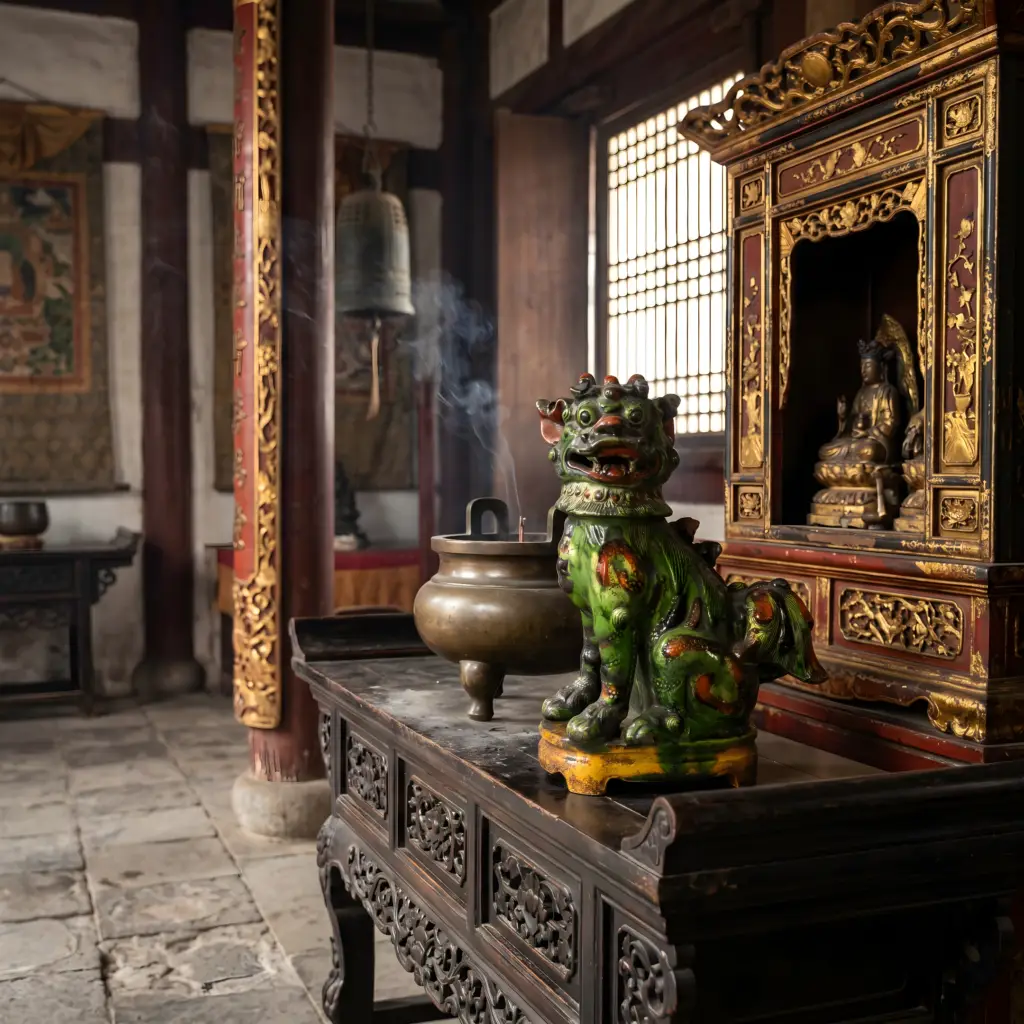
A boldly modelled and vigorously glazed Qing dynasty Buddhist guardian lion, glazed in the classic three-colour sancai palette of deep copper-green, amber-yellow and aubergine-black over a reddish-brown stoneware body.
The lion is depicted seated, head raised, mouth open to reveal teeth and tongue, the densely curled mane crowned with small horned bosses. The body is richly detailed with incised fur markings, a collar with pendant studs, and a small cub figure perched on the haunches; the upswept tail with flame-like lobes. A cylindrical candle socket between the forelegs confirms the piece’s function as a candlestick bearer for altar or domestic use. The stepped rectangular base with bracket feet is glazed in amber-yellow. Base unglazed, revealing the characteristic reddish-brown northern Chinese stoneware body; hollow construction.
Height: 60 cm. Base diameter: 19 cm.
Condition: Very good; minor surface wear consistent with age.
Price : 3250 Euro
Sterling Silver Figural Torch Lamp — Winged Putto
A fine and rare George V sterling silver figural table lamp, modelled as a winged putto (amorino) standing en contrapposto upon a gadrooned ovoid socle, one arm raised to support a ribbed torch nozzle crowned by a frosted pressed-glass flame-form shade. The circular base is chased with a band of acanthus foliage and framed by a beaded border; the stem features spiral gadrooning. The lamp rests on an ebonised wood plinth and is wired for electricity.
Fully hallmarked to the base rim with the maker’s mark W&W in trefoil for Wakely & Wheeler, the lion passant for sterling silver (.925), and the London date letter U for 1915/16.
Wakely & Wheeler were among London’s most accomplished silversmithing firms, their lineage traceable to John Lias’s workshop of 1791. Under James Wakely and Frank Clarke Wheeler the firm registered its distinctive interlaced monogram at Goldsmiths’ Hall in April 1909, producing work of consistently high quality through the first half of the twentieth century. Figural silver lamps of this scale and ambition — cast in solid sterling rather than electroplate — are exceptionally uncommon survivals.
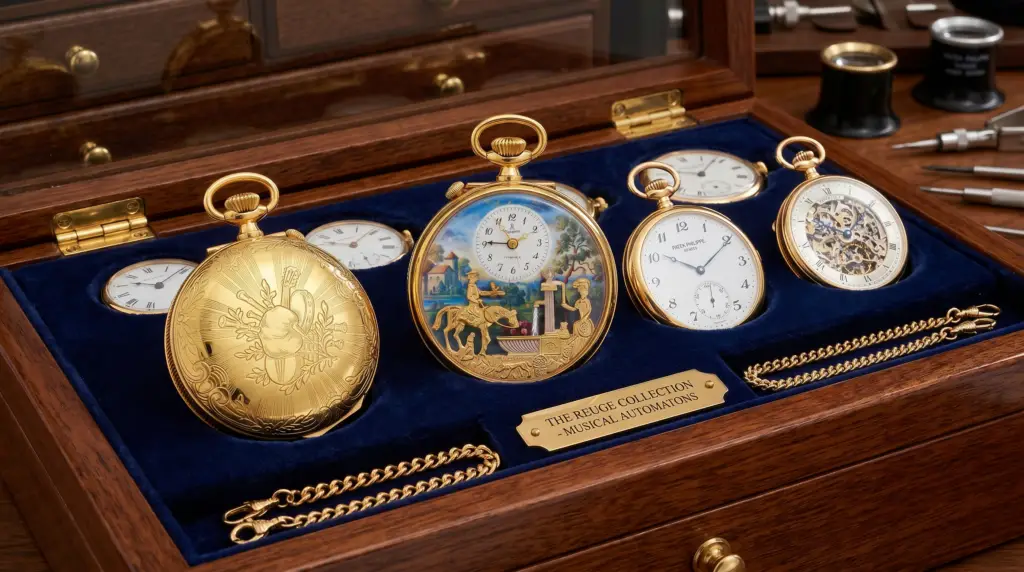
Maker: Reuge, Sainte-Croix, Switzerland
Retailed by: Boegli, Switzerland
Movement: Mechanical, 17 jewels, cylinder musical movement with automata
Case: Gold-plated metal (10 microns), hunter-case form
Serial no.: 1098 (inner case back)
Stand: Silvered metal, neoclassical column form, signed Boegli
Height (watch): c. 8 cm
Condition: Perfect
Price : 4000 Euro
Musical pocket watch with automata "the fountain" Circa. 1980
A delightful Swiss musical pocket watch with animated automata, produced by Reuge of Sainte-Croix, the foremost name in the tradition of mechanical musical horology.
The gold-plated hunter-case watch, gilt to 10 microns over engine-turned sides, opens to reveal a printed pastoral dial: a sunlit landscape with a lakeside château and trees forms the backdrop for three-dimensional applied gold-tone automata figures. A falconer on horseback and a lady standing at a column fountain are depicted in the foreground, with a dog and a market basket completing the rustic scene. When the cylinder musical movement is activated, the figures animate in concert with the melody: the horse’s head moves, the falconer raises his arm, and the lady simultaneously works the pump handle of the fountain. Activation is via a pusher on the interior of the case or by setting the alarm function. The small white enamel sub-dial carries Arabic hour numerals and is signed Reuge / 17 Jewels / Swiss Made.
The outer case back is finely engraved with a trophée musical, lyre, hunting horns, trumpets, laurel scrollwork. The traditional emblem of the musical watchmaking craft. The inner case back is signed Reuge à Sainte-Croix and numbered 1098.
The watch is presented on its original Boegli display stand in silvered metal, designed as a neoclassical portico with four fluted columns on a rectangular plinth, the fascia engraved Boegli. Suspended from the crossbar by its bow, the watch shows the animated dial to full decorative effect.
Comparable examples by Thomire et Cie were delivered to the Royal apartments at the Grand Trianon, Versailles, and are illustrated in the standard reference literature (Ledoux-Lebard, Le Grand Trianon, 1975, p. 128; Ottomeyer & Pröschel, Vergoldete Bronzen, 1986, pl. 5.17.12).
Condition: Good overall patina consistent with age; gilt surfaces retaining much of their original brilliance.
Price : 6500 Euro
Pair of French Gilt and Patinated Bronze Seven-Light Candelabra
A particularly Fine impressive pair of large-scale Restauration period candelabra of the finest quality, in the manner of the celebrated Parisian bronzier Pierre-Philippe Thomire (1751–1843).
Paris, circa 1820–1830 Height: 85 cm each
Each candelabrum rises from a concave-sided triangular base of richly veined rouge griotte marble, edged with a gilt-bronze bead-and-reel moulding, above which three boldly cast patinated bronze monopodia in the form of lion-paw feet support a gilt-bronze acanthus-wrapped knop. The tall fluted and tapered columnar shaft of patinated bronze is headed by an elaborately chased gilt-bronze capital with palmette and acanthus ornament, from which spring six sweeping patinated bronze candle arms, each enriched with fine foliate chasing and terminating in gilt-bronze vase-shaped nozzles with circular drip-pans. The arms are arranged around a taller central torch-light with a fluted trumpet-shaped nozzle. Between the arms, boldly modelled patinated bronze shield cartouches add a martial, neoclassical accent characteristic of the period.
The combination of fire-gilt and dark-patinated bronze. A technique perfected in the Parisian workshops of the early nineteenth century. Gives these candelabra an exceptional visual presence.
Fully hallmarked to the interior of the neck: maker's mark, lion passant, leopard's head (London), and date letter for 1884.
Literature:
Giovanni Battista Piranesi, Vasi, candelabra, cippi, sarcophagi, tripodi, lucerne, ed ornamenti disegnati ed incise dal Cav. Gio. Batt. Piranesi, Rome, 1778, pls. 109–110 — illustrating the Bacchanalian procession as reproduced on the Borghese Vase and on the present ewer
Trades and Manufactures of Great Britain, 1865 — contemporary account of Hunt & Roskell's Harrison Street workshop
Measurements:
Height: 38.5 cm
Weight: 1,070 g
Condition: Excellent. Gilding rich and largely intact throughout; relief work crisp and well-preserved.
Price : 5850 Euro
A Victorian Silver-Gilt Ewer by Hunt & Roskell
A magnificent Victorian silver-gilt ewer by Hunt & Roskell, one of the foremost luxury silversmiths of nineteenth-century London, stamped on the base HUNT & ROSKELL / LATE MORTIMER & STORR, numbered 8709.
The ewer is of classical oenochoe form, raised on a circular stepped foot with a tapering stem, the body surmounted by an elongated neck with trefoil lip and a sinuous serpentine handle enriched with acanthus leaves at its upper terminal and applied vine leaves at its lower junction. The neck is articulated by a band of rosettes above and a Vitruvian scroll below, between which appear ribbon-tied medallion cartouches set against Bacchanalian trophies — a thyrsus, pipes, and musical instruments.
The principal ovoid body, framed above by a band of entwined vines and below by a laurel frieze, carries an elaborate high-relief Bacchanalian procession after the Borghese Vase: Bacchus draped in a panther skin and bearing a thyrsus, accompanied by his wife Ariadne playing a lyre; a Satyr; and the figures of Maenads and male revellers playing castanets, tambourine, and panpipes. A further scene shows Bacchus supporting the elderly, rotund Silenus as he reaches unsteadily for a spilled wine cup — one of the most celebrated motifs of the antique relief tradition.
The Bacchanalian frieze is derived from the famous Borghese Vase, a monumental Pentelic marble krater carved in Athens in the first century A.D., rediscovered in 1566 in the gardens of Sallust in Rome, acquired by Napoleon Bonaparte in 1807, and today in the Musée du Louvre, Paris. The composition was widely disseminated through Giovanni Battista Piranesi’s influential Vasi, Candelabra, Cippi, Sarcofagi… (1778, pls. 109–110), which established it as a canonical source for Neoclassical decorative arts. Copies of the Borghese Vase were made in alabaster for Houghton Hall, Norfolk, and in bronze at Osterley Park, Middlesex; the composition was reproduced three times for the Bassin de Latone at Versailles, and in jasperware by Wedgwood. The same Bacchic frieze was adapted by Karl Friedrich Schinkel for a silver goblet in 1820, and reproduced on a reduced bronze scale by Giovanni Zoffoli in Rome (example c. 1795, Metropolitan Museum of Art, New York).
Paris, circa 1815–1825
The Makers: Pierre-Basile Lepaute (1750–1843) and his son Pierre-Michel Lepaute (1785–1849) operated their workshop jointly from 1811 under the name LePaute & Fils. The Lepaute family had held the prestigious title of Horloger du Roi, Clockmaker to the King, without interruption since 1751, serving Louis XV, Louis XVI, and Napoleon I (as Horloger de l'Empereur), before resuming the royal warrant under the restored Bourbon kings Louis XVIII and Charles X from 1814. Throughout their long history the firm collaborated with the foremost sculptors and bronziers of the day, and their clocks are preserved in the most distinguished European collections, including the Château de Versailles, the Château de Fontainebleau, the Musée du Louvre, and the Metropolitan Museum of Art, New York.
Condition: Very good. The gilding retains an even, warm patina. The marble is intact with no visible damage. The enamel dial is uncracked and clean.
Dimensions: H. 41 x W. 33 x D. 22 cm
Literature:
Tardy, Dictionnaire des Horlogers Français, Paris, p. 384
Pierre Kjellberg, Encyclopédie de la Pendule Française du Moyen Âge au XXe siècle, Les Editions de l'Amateur, Paris
Amis du Château de Fontainebleau, Dossier Horloges, No. 12, 2016 (Lepaute clocks documented in the royal apartments)
Price : 9500 Euro
Important Parisian Mantel Clock, signed LePaute & Fils, Horloger du Roi
An important Parisian mantel clock of the Restauration period, the white enamel dial signed LePaute & Fils / Hte du Roi, Clockmaker to the King, one of the most celebrated horological dynasties in French history.
The case of dark green veined marble (verde antico) takes the form of a stepped rectangular body with a cylindrical drum recess housing the movement, raised on a separately moulded concave-fronted black marble base. The mounts throughout are in fire-gilded bronze (bronze doré au feu) of outstanding quality and sharp chasing.
The decorative programme follows the full classical vocabulary: a pair of recumbent winged sphinxes with female heads flank the dial on either side, itself encircled by a double laurel wreath with central rosette finial and engine-turned gilt bezel over a convex glass. The lower frieze panel bears a centrally placed krater flanked by two winged female figures (victoires ailées) emerging from acanthus scrollwork, finely cast and chased throughout. Four winged bird monopodia at the corners of the upper plinth and a sunburst medallion to the flank complete the decorative scheme.
The white enamel dial with Roman numerals carries blued steel hands of characteristic Empire form with open-circle counterweight to the minute hand, and two winding squares indicating an eight-day movement striking the hours and half-hours on a single bell.
French, circa 1840
Height (urn and pedestal): 56 cm
Condition: Overall good decorative condition consistent with age.
Literature:
Alcouffe, Dion-Tenenbaum & Lefébure, Un âge d'or des arts décoratifs 1814–1848, Réunion des Musées Nationaux, Paris, 1991 for comparable gilt bronze mounted marble objects of the Restoration and Louis-Philippe periods
Kjellberg, Pierre, Le Mobilier Français du XIXe Siècle, Les Éditions de l'Amateur, Paris, 1987 for the broader decorative arts context of the period.
Price : 7500 Euro
A Pair of Louis-Philippe Campana Urns on Pedestals
An attractive pair of campana-form urns raised on matching square pedestals, executed in the tradition of the French Empire and its immediate successors. The bodies and pedestals are veneered in verde antico-style marble with characteristic dark green ground and white veining. The mounts are cast gilt bronze throughout, comprising a beaded and acanthus rim collar, bold acanthus-wrapped scroll handles, a pierced acanthus calyx to the lower body, a gadrooned and fluted baluster socle, and acanthus frieze to the plinth base, raised on four melon-gadrooned ball feet.
The campana form derived from the antique crater and popularised in France during the Napoleonic era remained fashionable throughout the Louis-Philippe period, and pairs of this type were widely produced for the prosperous bourgeois interior of the 1830s and 1840s.
Dimensions: height 80 cm, width 27.5 cm, depth 26.5 cm.
Condition: minor surface losses to the patina consistent with age and handling, structurally sound.
Literature:
F. Haskell and N. Penny, Taste and the Antique. The Lure of Classical Sculpture 1500 to 1900, New Haven and London, 1981.
A. Ruesch (ed.), Guida illustrata del Museo Nazionale di Napoli, Naples, 1908, no. 854.
S. Reinach, Répertoire de la statuaire grecque et romaine, Paris, 1897 to 1930, vol. II, p. 161.
Fonderia Artistica Chiurazzi. Catalogo generale, Naples, editions of circa 1910 and 1929, model listed among the reductions after Pompeian bronzes.
A. Dwyer, Pompeian Domestic Sculpture. A Study of Five Pompeian Houses and their Contents, Rome, 1982.
C. Gasparri (ed.), Le Sculture Farnese, Naples, and related Museo Archeologico Nazionale di Napoli publications on the bronzes from the Vesuvian sites.
Price : 2850 Euro
Grand Tour Bronze of the Dancing Faun after the Antique from Pompeii
A finely cast patinated bronze reduction of the celebrated Fauno Danzante, after the Roman bronze excavated in 1830 at the Casa del Fauno, Pompeii, and preserved since in the Museo Archeologico Nazionale di Napoli (inv. 5002).
The satyr is shown mid-dance, weight borne on the left leg with the right heel raised, the right arm extended aloft and the left bent with fingers snapping in the gesture of the crotala. The head is turned upward and slightly to the proper left, crowned with tousled curls from which emerge small goat horns, framing pointed ears and a bearded face with open mouth. The short caudal appendage, characteristic of the satyr iconography, is clearly modelled at the base of the spine. Raised on the original stepped square plinth cast integrally with the figure.
The surface bears a deep green oxidised patina imitating the archaeological encrustation of the Pompeian prototype, with warm reddish cuprite tones visible beneath on the torso and thighs, typical of the patine à l’antique applied by the great Neapolitan workshops (Chiurazzi, Sabatino De Angelis, Sommer) who supplied Grand Tour travellers and the international market from the second half of the 19th century onward.
Origin: Italy, Murano
Period: circa 1980
Dimensions: H. 145 cm, Ø 100 cm
Lights: 12
Condition: Perfect condition throughout, no losses or restorations.
Price : 8500 Euro
Monumental Twelve-Light Black Murano Glass Chandelier
An imposing Venetian chandelier of monumental proportions, blown in black Murano glass (vetro nero) and enriched with applied ornaments in colourless cristallo. The tiered construction follows the traditional Ca’ Rezzonico form, the central baluster shaft surmounted by a trumpet vase issuing sprays of stylised leaves, reeds and ribbon scrolls, the whole profusely dressed with rosettes and flowerheads worked in pastiglia.
The scrolling branches support twelve candle nozzles with finely ribbed bobèches, the lower section concluding in a graduated bowl and turned pendant finial.
The dramatic contrast between the deep saturated black of the principal elements and the translucent clarity of the floral mounts is characteristic of a model particularly prized for its theatrical presence and rarely encountered at this scale. The type revives the eighteenth century lighting preserved at the Palazzo Ca’ Rezzonico in Venice, a model reinterpreted by the Murano glasshouses from the later nineteenth century onwards.
Condition:
Janbiya I: silver mounts with consistent age patination; belt textile faded but complete; blades with use patination.
Janbiya II: gilt metal mounts with surface wear and some losses to underlying material at the bolster; filigree wire decoration largely intact; blade bright and sound.
Literature:
Elgood, Robert: The Arms and Armour of Arabia in the 18th, 19th and 20th Centuries, Scolar Press, Aldershot, 1994
Elgood, Robert (ed.): Islamic Arms and Armour, Scolar Press, London, 1979
Stone, George Cameron: A Glossary of the Construction, Decoration and Use of Arms and Armor in All Countries and in All Times, Southworth Press, Portland, 1934 (repr. Jack Brussel, New York, 1961), pp. 310–311 (s.v. "Janbiya")
Hales, Robert: Islamic and Oriental Arms and Armour: A Lifetime's Passion, Robert Hales Ltd., London, 2013
Price : 1250 Euro
Pair of yemeni janbiya daggers with scabbards
A rare 19th century ensemble of two Yemeni janbiya daggers with their scabbards, an original woven hizam belt, and a companion sikkin, representing two distinct regional traditions of Yemeni silversmithing.
The first is a Sanaa highland type, with horn handle, granulated silver mounts, and a kidney shaped scabbard worked in repoussé with scrolling arabesques over deliberately oxidised grounds. The second is a southern Yemeni or Hadhramaut coastal type, with a broad flat T bar gilt metal pommel and a scabbard entirely covered in applied twisted and beaded wire filigree of considerable technical refinement.
Together with the brocade hizam and stone set sikkin, the group forms an instructive complementary pairing of the kind assembled by 19th century European travellers and diplomats in Arabia, more varied and revealing than two matched examples.
Height 44 cm, width 29 cm, depth 19 cm.
The celebrated Lépine firm was founded by Jean-Antoine I Lépine (1720–1814), Horloger du Roi to Louis XV and Louis XVI and inventor of the calibre Lépine. The firm passed in 1784 to his son-in-law Pierre-Claude Raguet-Lépine (1753–1810), who maintained the prestigious Lépine Horloger du Roi signature throughout his directorship. At the date of this clock the workshop remained one of the most distinguished in Paris, supplying movements to the Imperial court and the foremost bronziers of the day.
Literature: P. Kjellberg, Encyclopédie de la pendule française du Moyen Âge au XXe siècle, Paris, 1997; Tardy, La Pendule française, des origines à nos jours, Paris, 1964–67; J.-D. Augarde, Les Ouvriers du Temps, Geneva, 1996.
Price : 5000 Euro
A fine French Empire ormolu mantel clock, circa 1810
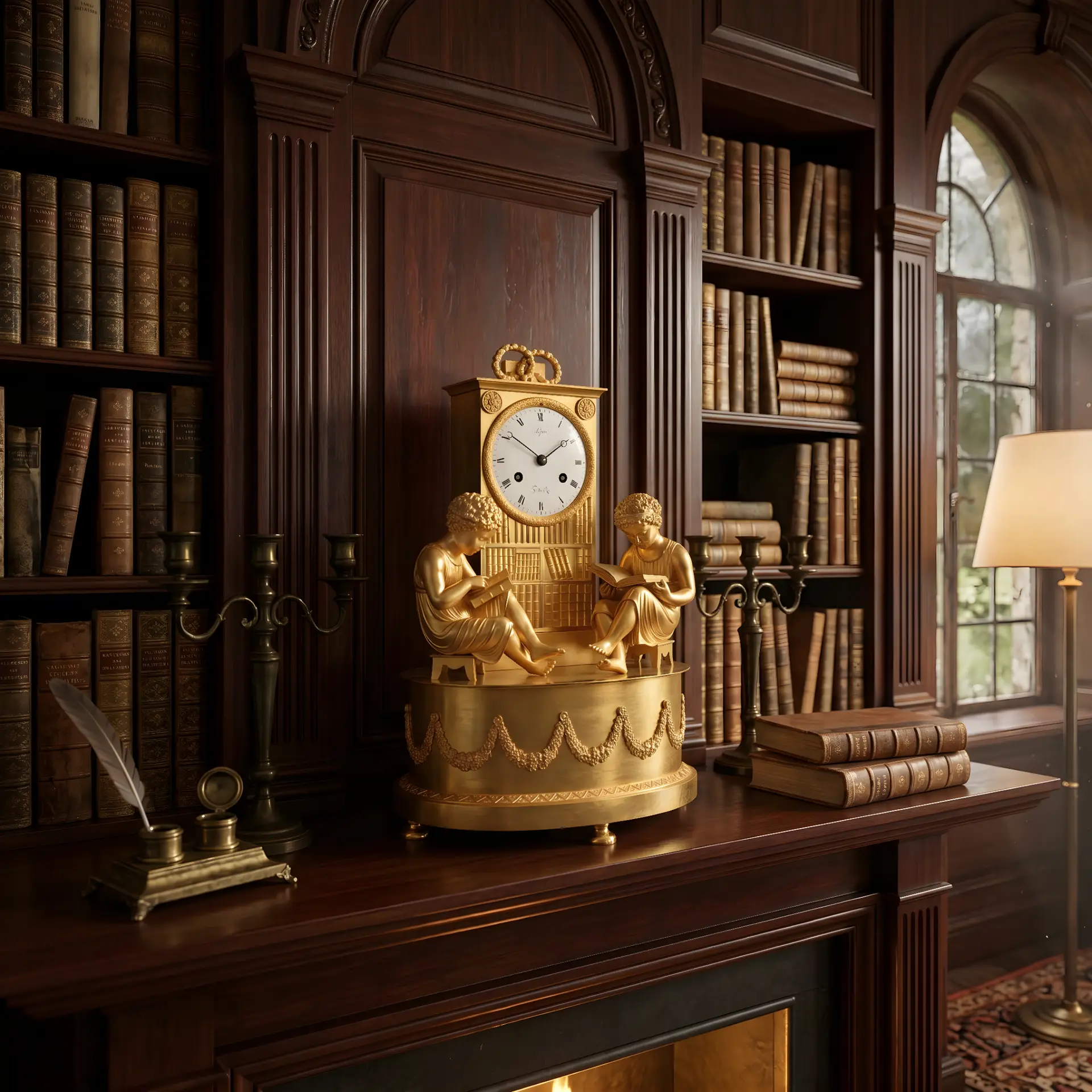
A fine French Empire ormolu mantel clock (pendule de bibliothèque aux liseurs), the white enamel dial signed Lépine, H’r du Roi, à Paris, circa 1800/1810.
The case of rectangular bookcase form in finely chased fire gilt bronze, the face cast with three tiers of book spines in full relief, set within a beaded bezel and surmounted by a floral wreath finial above a plain cornice with rosette corner medallions. Flanking the case on a raised gilt bronze platform, two finely cast and chased seated figures in antique dress, a young man to the left and a young woman to the right, both absorbed in reading and seated on pierced Gothic arch supports. The whole raised on a large cylindrical drum base with brushed gilt finish, applied with swaged festoon ornament in matted bronze, the foot with an engraved chevron border, on three ball feet.
The white enamel dial with Roman chapter ring and fine minute track, signed Lépine above and h’r du Roi below centre, within a beaded and engine turned gilt bronze bezel. Two train movement with silk thread suspension, striking the hours and half hours on a bell.
Height: 56 cm | Width: 34 cm | Depth: 15 cm
Condition: One tusk repaired; otherwise very good
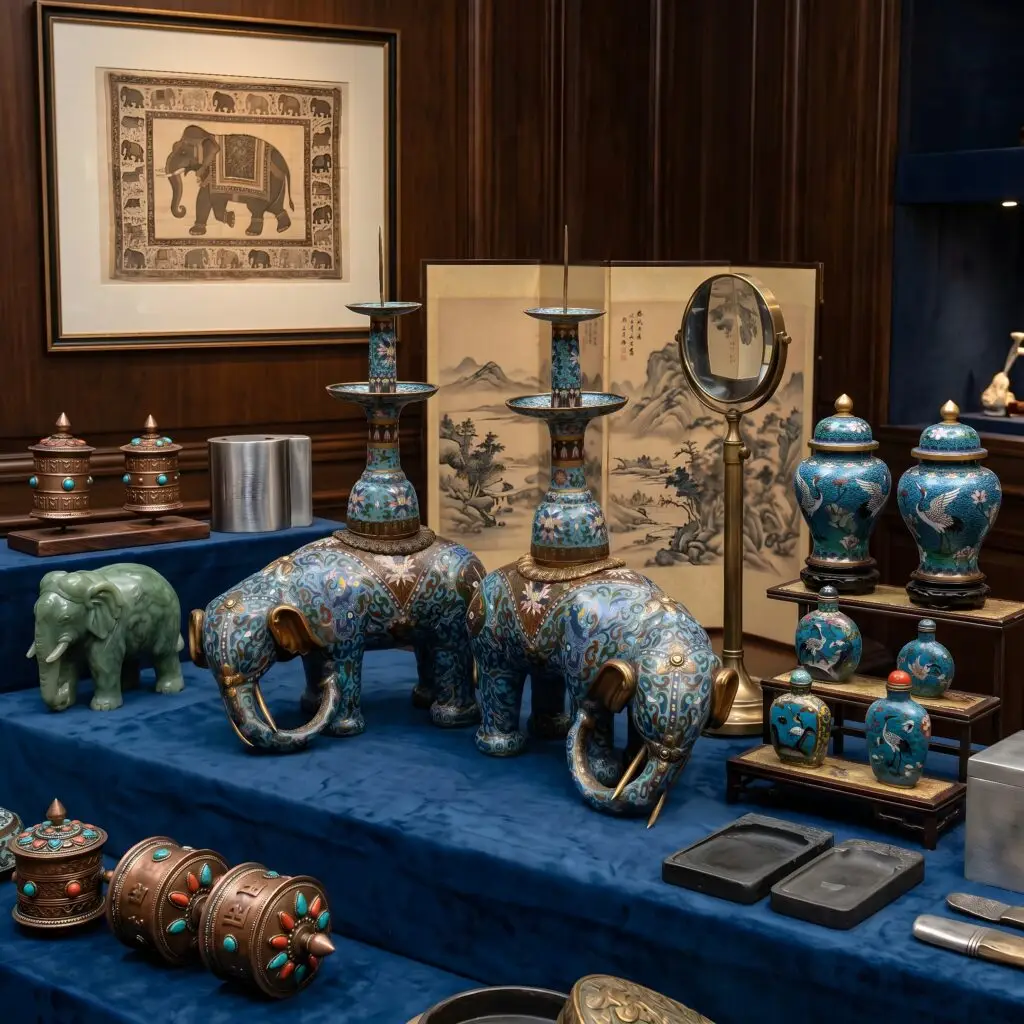
Price : 3850 Euro
A Pair of Chinese Cloisonné Enamel Elephants, China circa 1880–1910
Each modelled as a kneeling elephant with trunk curled downward, the body entirely worked in cloisonné enamel on a turquoise ground with dense scrolling lotus and foliate arabesques in polychrome enamels of navy blue, aubergine, sage green, pink, white and yellow, the caparison reserved with lotus medallions on a dark blue ground. Gilt bronze details throughout: cast tusks, chased ear and trunk tips, and a repoussé foliate collar separating the elephant from the removable candlestick shaft above. The tall shaft of waisted form, enamelled en suite with lotus and cloud motifs, issuing two tiered drip trays and terminating in an iron spike pricket. Shafts original to bases.
The elephant form pricket candlestick belongs to a well established tradition of Buddhist altar furniture in China. Such candlesticks typically formed part of a wǔgòng (五供, “five offerings”) altar garniture comprising a central incense burner, a pair of flower vases, and a pair of candlesticks. As noted by Béatrice Quette (Cloisonné: Chinese Enamels from the Yuan, Ming and Qing Dynasties, Yale University Press and Bard Graduate Center, 2011), altar sets were kept in stock in the palace storerooms and assembled into garnitures when needed, the wǔgòng format being equally adopted for temple and aristocratic interiors throughout the Qing period. The technique of cloisonné itself, in which designs are created on metal vessels with coloured glass paste placed within enclosures made of copper or bronze wires bent or hammered into the desired patterns, was brought to its most elaborate expression during the 18th and 19th centuries. For comparable examples, see Helmut Brinker and Albert Lutz, Chinese Cloisonné: The Pierre Uldry Collection (New York: Asia Society, 1989).
Chamber candlesticks of this quality — with fine engraved decoration, original extinguisher and legible hallmarks — are increasingly rare to find complete and unrestored. This example is in very good original condition, with the expected light surface wear consistent with nearly 250 years of age.
Maker: James Jones, London Date: 1777 (date letter b, George III)
Standard: Sterling silver, 925/1000 Dimensions: Height 8.5 cm | Diameter approx. 17 cm
Literature:
Grimwade, Arthur G., London Goldsmiths 1697–1837: Their Marks and Lives, Faber & Faber, London, 1976 (3rd ed. 1990)
Jackson, Sir Charles J., English Goldsmiths and their Marks, 2nd ed., London, 1921 (repr. Dover Publications, New York, 1964)
Bradbury, Frederick, Book of Hallmarks, J.W. Northend, Sheffield (various editions)
Price : 2850 Euro
George III Sterling Silver Chamberstick with Original Extinguisher
A fine and complete George III sterling silver chamber candlestick, hallmarked London 1777 by the silversmith James Jones.
Of circular form, the broad drip pan is raised on a moulded foot ring and enclosed by a finely worked continuous beaded border. The pan is richly engraved throughout with bold Rococo scrollwork, foliate sprays and floral medallions in the characteristic taste of the 1770s, incorporating a central armorial cartouche with the original owner’s engraved monogram.
The central candle socket rises from a circular base with matching beaded collar, its shoulder engraved en suite with the pan. The elegant scroll handle, cast and applied, terminates in a shaped thumb-piece with foliate decoration; a charming and practical period feature.
The original conical extinguisher, stored on a bracket attached to the handle, is engraved with matching Rococo scrollwork and fitted with a beaded base ring and suspension loop, confirming it as original to the piece. The reverse of the pan bears a complete and crisp set of London hallmarks: maker’s mark IJ for James Jones, lion passant (sterling standard, 925/1000), date letter b for 1777, and the leopard’s head (London Assay Office). A Swiss import control mark is also present, indicating the piece entered Switzerland at some point following its manufacture.
James Jones is recorded as an active London silversmith from at least 1755, appearing in the standard reference works for the period. His work reflects the assured craftsmanship of the London trade at the height of the Georgian era.
Dimensions: H. 30 cm · W. 20 cm · D. 5 cm.
Literature (comparable):
H. Ottomeyer, P. Pröschel et al., Vergoldete Bronzen. Die Bronzearbeiten des Spätbarock und Klassizismus, Munich, 1986, vol. I, chapters on Empire bronzes d'ameublement.
J.-P. Samoyault, Pendules et bronzes d'ameublement entrés sous le Premier Empire, RMN, Paris, 1989.
M.-F. Dupuy-Baylet, L'heure, le feu, la lumière. Les Bronzes du Mobilier National 1800-1870, Éditions Faton, Dijon, 2010.
D. Ledoux-Lebard, Les ébénistes du XIXe siècle, Paris, 1984.
Price : 1100 Euro
Pair of Empire Fireplace Fronts, 1810
A pair of French Empire fireplace fronts in patinated and gilt bronze, Paris, circa 1805-1815.
Each front of architectural form, the rectangular plinth surmounted at either end by a cylindrical drum applied with a gilt rosette, the drums flanking a central recessed panel mounted with two confronted swans with outspread wings flanking a central trident surmounted by a palmette and acanthus scrollwork. Flanking pilasters mounted with ajouré palmette and acanthus trails. Reverse with original wrought iron back plate secured through squared nuts. The shallow depth indicates that the present pair were conceived as devants de cheminée (decorative façades), rather than as functional firedogs with extended iron billet bars.
Paris, First Empire, circa 1810. Unmarked.
The swan, emblem of the Empress Josephine, saturated the decorative vocabulary of the Empire period, appearing on seat furniture, bronzes d’ameublement, textiles and vessels after 1804. Paired with a trident, Neptune’s attribute, the composition introduces a marine iconography particularly suited to a fireplace, where the opposition of fire and water was a recurring conceit in Parisian bronze design. Comparable confronted-swan motifs appear on documented chenets, wall lights and firedogs delivered by the great Parisian bronziers of the period, notably Pierre-Philippe Thomire (1751-1843), André-Antoine Ravrio (1759-1814), Claude Galle (1759-1815) and Jean-Simon Deverberie (1764-1824).
The modest scale suits a small fireplace, or alternative display on a mantelpiece, commode or bookshelf, where the pair function equally well as decorative objects or as substantial bookends.
Condition: Gilt bronze mounts re-gilded. Patinated bronze ground retaining a fine dark green-black patina. Casting crisp, chasing well preserved. Iron back plates intact.
Original mercury silvered plate present, with foxing and oxidation entirely consistent with the period of manufacture. Some minor losses and craquelure to the composition at the lower volutes and pin sized flaking, all consistent with age and wholly stable.
Literature: Denise Ledoux Lebard, Le mobilier français du XIXe siècle, Paris, Editions de l'Amateur, 1989; Camille Mestdagh, L'ameublement d'art français 1850 1900, Paris, Editions de l'Amateur, 2010.
Price : on request
Important Napoleon III Giltwood and Composition Pier Mirror with Caryatids and Putti, France, circa 1865 to 1875
A large and architecturally conceived pier mirror in giltwood and moulded composition (stuc), water gilded with the customary contrast of burnished and matt areas (or et or mat), in the Louis XVI revival taste of the Second Empire. The rectangular bevelled plate, retaining its original mercury silvering, is set within an arched cresting elaborately modelled with a central oval beaded medallion bearing the profile bust of an idealised classical female facing left, suspended from a fluttering ribbon bow and flanked by two reclining putti holding palm branches, all above a moulded entablature dressed with rinceaux, beaded astragals, and pendant swags of flowers and fruit. The cresting is bracketed at either side by flame urn finials on socle plinths hung with husk chains.
Each upright is mounted at the upper third with a finely modelled standing female nude in the manner of an architectural caryatid, arms raised and hair gathered, terminating en gaine in an acanthus volute. Beneath each figure runs a Greek key panel, then a long ribboned guilloche infill flanked by beaded mouldings. The lower corners feature large scrolled volutes with central rosettes of stylised acanthus, applied with bouquets of flowers tied at the throat, all above an architectural fluted plinth.
Frame 130 x 215 cm. Plate 92 x 165 cm.
A textbook example of the mode néo Louis XVI of the third quarter of the nineteenth century, in which the ornamental vocabulary of the 1770s and 1780s (ribbon bows, beaded medallion, putti, husks, urn finials, Greek key) is reinterpreted at theatrical scale and with sculptural exuberance characteristic of the great Paris workshops of the Faubourg Saint Antoine. Comparable pier mirrors were supplied for the hôtels particuliers and provincial châteaux being decorated under Napoleon III and the early Third Republic.
Literature:
J. Ramon Colon De Carvajal, “Catalogo De Relojes Del Patrimonio Nacional”, 1987, p. 292, no. 278, illustrating a similar clock case but simpler movement in the Spanish Royal Collection.
Derek Roberts, “Precision Pendulum Clocks”, 2004, p. 100, pl. 31-16, illustrating a table regulator by Autray Fils à Paris, housed in a comparable gilt bronze case.
Signed on the white enamel chapter ring Comminges Palais Royal N.o 62
Condition: very good
Price : 7500 Euro
A late Empire table regulator by Comminges
A very fine late Empire gilt bronze table regulator by Comminges à Paris of fourteen day duration, signed on the white enamel chapter ring Comminges Palais Royal N.o 62, the chapter ring with Roman hour numerals and indications for the minutes with blued steel Breguet style hands, the engine turned brass dial centre set with two subsidiary calendar dials, the top one marked 0-31 for the days of the month and the lower with the abbreviated names of the days of the week, both with blued steel pointers. The movement with anchor escapement, striking on the hour and half hour, outside count wheel and a free winging nine rod gridiron compensated pendulum above a large brass bob. The gilt bronze case of architectural form with a stepped rectangular top with anthemion and acanthus as well as egg and dart borders supported on a pair of circular fluted columns with Corinthian capitals, the dial with foliate bezel and drum suspended between the upper parts of columns, the base of each column with a berried laurel leaf band upon a square plinth, both resting on a stepped rectangular base ornamented by egg and dart banding and a foliate border
Paris, date circa 1820
Few clocks by Comminges à Paris and of this design are known. The architectural case compares with many other column clocks of this period but here the columns are distinguished by rare ornate Corinthian capitals. In this respect, it compares with another regulator in the Spanish Royal collection though the latter has a less complex movement. Whilst the case is not signed, its quality and form can be compared to those produced by such eminent bronziers as Pierre-Philippe Thomire or Lucien-François Feuchère and his father Pierre-François Feuchère.
Although Comminges was evidently a fine Paris clockmaker, little is known about this business except that it was listed in the commercial directories of the period as well as in Tardy. The dial notes its address as Palais Royal No 62, while Tardy more specifically lists it at the Galerie de Pierre at the Palais Royal. From about 1830 Comminges was based at Galerie Montpensier and then from about 1839 up until the 1850s it was listed in the Paris trade directories at 47 rue Richelieu. At the time of the clock’s creation, Comminges was based at the Palais Royal, which was a very prestigious location, set within an arcade of galleries that offered a variety of luxury goods for sale. The Palais Royal was in fact built in 1633 for Cardinal Richelieu. Ten years later the buildings were bequeathed to Louis XIV and then passed to the d’Orléans family. Shortly after 1785 the duc d’Orléans (Philippe Egalité) opened its gardens to the public and the buildings to the trade. Jewellers, watch and clockmakers alike were all keen to set up businesses within its precincts. Among them were such distinguished horologists as Leroy who at no 60 Galerie de Pierre, was adjacent to Comminges. Other clockmakers based there included Charles Oudin, while Kinable had also previously operated from under the same roof. It was not only the luxury trades that drew in the public but also the gambling halls; after they were ordered to be closed in 1836 far less people visited the Palais Royal. In turn, many of the former galleries moved to the grand boulevards, which is why Comminges relocated to rue Richelieu.
Literature:
H. Ottomeyer and P. Pröschel, Vergoldete Bronzen. Die Bronzearbeiten des Spätbarock und Klassizismus, Munich, 1986, vol. I, pp. 270-289, for comparable Louis XVI gilt bronze chandeliers.
D. Alcouffe, A. Dion-Tenenbaum and G. Mabille, Gilt Bronzes in the Louvre, Dijon, 2004, for related models and mounts.
P. Verlet, Les Bronzes dorés français du XVIIIe siècle, Paris, 1987, for the Louis XVI vocabulary revived in the late 19th century.
Dimensions: H. 96 cm x D. 66 cm
Price : 3850 Euro
Louis XVI Style Gilt Bronze and Cut Crystal Sixteen-Light Chandelier
A French gilt bronze and cut crystal chandelier in the Louis XVI taste, late 19th century, with sixteen lights arranged on two tiers of eight arms around a central baluster shaft. The shaft cast with neoclassical ornament including acanthus foliage, stiff-leaf collars, fluting and a stylised urn, issuing scrolled foliate arms supporting turned candle cups and drip pans. Richly hung with cut crystal pendeloques, spear-point plaquettes, faceted button chains and graduated swags, terminating in a cut crystal ball finial. Retaining its original mercury gilding with mellow tone. Electrified for use.
Condition: Very good. Gilding refreshed. No structural losses or repairs observed. Original casting quality throughout.
Price: on request
A Pair of Gilt Bronze Two-Branch Figural Wall Lights, circa 1745
A fine and rare pair of gilt bronze two-branch figural wall lights (appliques à deux bras de lumière), Paris, circa 1745, in the Régence manner after designs by Gilles-Marie Oppenordt (1672–1742).
Paris, circa 1745
Each wall light is formed as a tapering foliate backplate terminating in an acanthus finial, centred by a putto figure in high relief holding aloft the asymmetric two-branch structure. The scrolling branches, richly cast with acanthus leaves and flowering tendrils, terminate in circular drip-pans of exceptional quality, each chased with a dense hexagonal rosette ground beneath a beaded rim and a shell-form (coquille) nozzle with finely gadrooned support. The two figures are mirror images of one another (en regard), confirming that the pair was conceived and cast together from the outset. The gilding has been refreshed. Hollow-cast, with original differential patination visible on the interior of the backplate.
Height: 68 cm. A pair.
Design source and comparable examples:
The design derives from an engraving by Gilles-Marie Oppenordt, published by Gabriel Hucquier in the Livre de différentes décorations d’appartements par G. M. Oppenord architecte, Paris, circa 1730. A closely related wall light in the same manner, from Schloss Fasanerie, Fulda, is illustrated in Hans Ottomeyer & Peter Pröschel, Vergoldete Bronzen, Die Bronzearbeiten des Spätbarock und Klassizismus, Klinkhardt & Biermann, Munich, 1986, vol. I, cat. 1.9.20–1.9.21. Further variants of the model are preserved in the Cooper-Hewitt Smithsonian Design Museum, New York (inv. 1921-6-216-74), and in the Rothschild Collection at Waddesdon Manor (cf. Geoffrey de Bellaigue, The James A. de Rothschild Collection at Waddesdon Manor, 1974, vol. II, pp. 790–791, no. 216).
A closely comparable pair of wall lights of the same design lineage and period, also citing Ottomeyer/Pröschel fig. 1.9.20, was offered at Sotheby’s Paris, Style, Mobilier et Objets d’Art, November 2020. Pairs of 19th-century versions after the same Oppenordt design have been offered at Koller Zurich with estimates of CHF 12,000–18,000; original 18th-century examples with strong scholarly credentials have realised €50,000–78,750 at Osenat Versailles (Grands Siècles sales).
Dimensions: Height 70 cm | Width 27 cm | Base 15 × 15 cm (each)
Material: Ormolu (mercury-gilt bronze) and patinated bronze
Period: French Empire, Paris, circa 1805–1815
Condition: Very good; gilding bright and fresh; both pieces complete and matching
Price : on request
A Pair of French Empire Five-Light Candelabra, Ormolu & Patinated
Each candelabrum is formed as a winged Egyptian herm: a draped female bust with Egyptian headdress rising from a square tapering shaft of black patinated bronze. Four scrolling cornucopia branches support trumpet-shaped bobeches finely chased with mask-heads; a fifth socket crowns the figure’s head on a lotus capital. The large feathered wings spread dramatically behind the coiffed head. The shaft is applied to the front with a winged flaming torch in ormolu, flanked by mask medallions to the sides. The pedestal mounts alternate Egyptian heads and lyres against palmette grounds. Each piece rests on a square socle with a bold acanthus leaf band in ormolu.
Paris, circa 1805–1815.
The outstanding quality of the chasing and gilding, together with the rich iconographic programme of the Retour d’Égypte — inspired by Vivant Denon’s Voyage dans la Basse et la Haute Égypte (1802) and the design vocabulary of Percier & Fontaine — points to one of the foremost Parisian bronze foundries of the early Imperial period, possibly from the circle of Claude Galle or Pierre-Philippe Thomire.
Condition: very good with the normal evidence of age, with minor surface pitting to the enamel here and there and the gilding well preserved.
Sice: L: 35cm x D: 13cm x H: 15cm
Price: 1300 Euro
A Chinese Cloisonné Enamel Rectangular Censer and Cover Qing Dynasty, second half of the 19th century
The casket of rectangular outline and slightly waisted bombé form rises on four openwork bracket feet of archaistic fretwork pattern and supports a fully reticulated cover composed of an interlaced lattice diaper, the open trellis pierced through to the body so that the fumes of the incense might escape freely. The whole is finely worked in cloisonné enamel on a rich turquoise ground with a continuous frieze of formal lotus blossoms borne upon dense leafy scrollwork, the principal flowers shown frontally with ruby and white petals about blue and ochre seedpods, flanked by pairs of stylised feathered tendrils issuing in the manner of archaistic kuilong scrolls. A formal Greek key border (leiwen) in dark blue on a buff ground encircles the upper register of the body beneath the gilt rim, while a band of polychrome lappets enclosing florets descends to the foot. The interior holds a removable gilt copper liner pierced at its base with three large openwork medallions of cash pattern (qian wen) for the circulation of air, retained by two opposing gilt strap handles. The framing wires and rims throughout are richly fire gilt.
The rectangular waisted form, conceived in the manner of a miniature throne or altar table, is a relatively uncommon type within the late Qing cloisonné repertoire and reflects a deliberate evocation of archaistic bronze and lacquer prototypes. The combination of the openwork lattice cover with the cash medallions of the inner tray strongly suggests use as a perfume burner or aromatic brazier (xun lu), intended to stand upon an altar or in a scholar’s studio, where the slow combustion of fragrant woods would diffuse their scent through the lattice of the cover. The clarity of the turquoise ground, the warm depth of the ruby and aubergine enamels and the regular drawing of the lotus all point to the better quality of metropolitan Beijing workshop production of the Tongzhi to Guangxu era.
Condition: Very good. Gilding refreshed. No structural losses or repairs observed. Original casting quality throughout.
Price: 4500 Euro
Astronomical Longcase Clock with Day, Month, Date and Moon Phase Indication
A fine and unusual Dutch Baroque longcase clock with full astronomical calendar and rare painted ships automaton (scheepjes) mechanism, the movement signed Johan Smit Amsterdam. Amsterdam, 18th century.
Case:
Rectangular longcase clock in walnut, inlaid with light and dark stringing and carved with rocailles and a flower basket. Architectural hood with partially glazed sides and three gilt finial figures. Bombé base on claw feet – a characteristic feature of Amsterdam high Baroque production.
Dial & Movement:
Silvered and engraved chapter ring with Roman hour numerals and Arabic minute numerals. Centre seconds hand with apertures for month, day and moon phase. The movement signed and inscribed Johan Smit Amsterdam. The dial is painted as a theatrical backdrop depicting a Dutch bay with sailing ships (scheepjes) that rock in time with the escapement – a technically accomplished and decoratively distinctive feature of high-end Amsterdam clockmaking of the 18th century. Quarter-hour strike on one bell; hour and half-hour strike on two bells. Brass weights. The movement is in running order.
Dimensions: 73 × 37 × 296 cm
Comparative examples:
A closely related example with a similar case is preserved in the Musée David et Alice Van Buuren, Uccle, Belgium (Inv. 11015189), where the dial is signed by the clockmaker Johannes du Chesne and dated to circa 1730–1750. A further longcase clock of nearly identical case form and bearing the same signature was offered on the French art market in 2013 (Vente aux enchères à Cheverny, Lot 106).
In overall fine condition. The glaze is even and undamaged across the body, drapery and lotus throne. The eighteen radiating arms, by far the most vulnerable element of the composition, are integrally preserved, with no visible losses, restorations or breaks. Light surface wear and minor accretions consistent with age and devotional handling. The unglazed interior of the pedestal shows the natural surface of the biscuit.
Price : 2200 Euro
A Chinese Dehua Blanc de Chine Porcelain Figure of the Eighteen Armed Guanyin (Cundi / Zhunti Pusa)
A substantial and finely modelled figure in Blanc de Chine porcelain depicting Guanyin in her esoteric eighteen armed manifestation, known in Chinese as Zhunti Pusa (準提菩薩, Sanskrit Cundī), seated in dhyanasana upon a tall double lotus throne raised on a stepped hexagonal pedestal. The bodhisattva is represented frontally, the body draped in flowing celestial robes that fall in soft cascades over the lotus seat, the high foliate crown adorned at the front with a small seated figure of Amitabha Buddha, the defining attribute identifying the deity as a manifestation of Avalokiteshvara. The face is rendered with serene introspection, the eyes lowered in meditation, the brow marked with the urna, the gentle smile and youthful features lending the figure a contemplative grace characteristic of the finest Dehua devotional production.
The principal pair of hands is joined before the chest in anjali mudra, the gesture of veneration. A second pair rests in the lap in dhyana mudra holding a wish granting cintamani jewel. A third pair is raised symmetrically high above the head bearing lotus blossoms in full bloom flanking the crown. The remaining twelve arms radiate in elegant tiers to either side, the open palms displaying a variety of mudras and originally intended to support attributes alluding to the bodhisattva’s boundless capacity to come to the aid of sentient beings. Each arm is articulated with bracelets and the fingers delicately individuated, demonstrating the considerable technical skill required to fire so many projecting elements without warpage or collapse.
The hexagonal pedestal is worked in low relief with bands of stylised endless knot and ruyi fretwork on each face, the upper edge moulded as overlapping lotus petals that support the seat, the petal tips each crisply defined. The reverse of the throne bears two impressed seal marks: a figural pictorial mark within an oval cartouche above a square character cartouche, a configuration consistent with workshop or studio marks of the late Qing and Republic Dehua kilns. The construction is hollow with an open underside, as expected for Dehua porcelain figures of substantial scale, the interior left in the unglazed biscuit state.
The eighteen armed iconography codified in the Sutra of Cundi expresses her capacity to act simultaneously in eighteen directions for the salvation of beings, each hand bearing or displaying an attribute corresponding to a specific virtue or function: the lotus of purity, the vajra of indestructible truth, the vase of nectar, the rosary of accumulated merit, the alms bowl of renunciation, the sword of discriminating wisdom, the wheel of the dharma, and so on. In Chinese popular practice the figure is frequently identified directly with Guanyin and is invoked as Cundi Guanyin or Zhunti Guanyin, the maternal protectress of practitioners and the bestower of children, longevity and worldly success. The crowning miniature Amitabha confirms the bodhisattva’s identification within the broader Avalokiteshvara cycle.
Comparable marks are recorded on works associated with the Su family workshops and other major Republic period Dehua ateliers active during the early decades of the twentieth century.
Condition: In overall fine condition.
Price: 1300 Euro
A Chinese Blanc de Chine Porcelain Figure of Buddha Seated upon a Lotus Throne with Dragon and Tiger in Relief
Dehua, Fujian Province, late Qing dynasty to early Republic period, circa 1880 to 1920
The Buddha is finely modelled in the relaxed posture of lalitasana, or royal ease, one leg pendant and the other tucked inward upon a tiered lotus throne, the hands held quietly before the body cradling a small offering vessel. The serene and meditative expression is conveyed through the gently downcast eyes, the delicately drawn brow and the soft contour of the cheeks, the whole crowned by a high ushnisha rendered in tightly coiled curls and centred by a discreet urna at the forehead. Long pendulous earlobes frame the face. The exposed chest bears in low relief the wan emblem, an ancient Buddhist mark of auspicious eternity, set above a finely beaded necklace terminating in three tasselled pendants. The monastic robe drapes the body in supple, naturalistic folds, the hem cascading over the front of the lotus base in broad sculptural rhythms.
The lotus throne is conceived as a tall cylindrical mass crowned by a tier of upturned petals, the lower register entirely given over to an animated frieze in deep relief. At the left a dragon writhes amid cloud and surf; at the right a tiger emerges from a rocky outcrop, the two beasts confronting a central flaming pearl rising upon stylised waves. This composition, known in Chinese iconography as longhu douzhu, depicts the eternal contest of dragon and tiger for the radiant pearl and embodies the harmonious tension of complementary cosmic forces, of yin and yang. The presence of the Buddha enthroned in serene transcendence above this scene gives the ensemble a clearly soteriological reading: the Awakened One presides over the play of opposites and rises beyond it.
Modelled in the warm ivory porcelain that has long defined the kilns of Dehua in Fujian Province, the figure displays the soft, slightly glassy covering for which blanc de Chine has been celebrated since the seventeenth century. The glaze pools more deeply within the recesses of the relief base, lending the modelling its characteristic luminosity. The assured carving, the refinement of the facial features and the confident sculptural treatment of the dragon and tiger frieze inscribe this work firmly within the mature tradition of Dehua devotional sculpture of the late nineteenth and early twentieth centuries.
Literature
Elke Niehüser, Die Französische Bronzeuhr, Munich, 1997, for a closely related example with yoyo group.
Jean-Pierre Samoyault, Mobilier Français Consulat et Empire, Paris, 2009, p. 50, pl. 60 (Jacob Frères fauteuils, Fontainebleau); p. 56, pl. 74 (Bonaparte fauteuils, rue Saint-Dominique); p. 180, pls. 310–311 (Marcion tabourets, Compiègne).
Marie-Noëlle de Grandry, Le Mobilier Français, Directoire Consulat Empire, Paris, 1996, p. 51.
Denise Ledoux-Lebard, Le Mobilier Français du XIXe Siècle, Paris, 2000, p. 283
Price: 4850 Euro
A French Empire Gilt and Patinated Bronze and Marble Mantel Clock
The white enamel dial signed à Paris, with Roman and Arabic numerals and blued steel moon-style hands. Eight-day movement with silk thread suspension, anchor escapement, outside count wheel, striking the hours and half-hours on a single bell.
Circa.1810, Paris
The case depicting a young mother seated in an Egyptian Revival fauteuil, dressed in a classical tunic, playing a game of ball and cup (bilboquet) with her young son, who stands on a cushioned tabouret de pied and reaches upward. The fauteuil of pronounced Empire character, with scroll back, winged sphinx arm supports, sabre back legs and straight front legs terminating in lion paw feet. The footstool with scrolled acanthus apron and corresponding feet. A dog and cat are included in the composition beside the chair, alluding to domestic fidelity and, in the case of the cat, to the prevailing Egyptomania of the period.
The white enamel dial asymmetrically set within an octagonal-section rectangular plinth, mounted at the front with classical pitchers and a ram — attributes of Mercury in his role as protector of shepherds — and at the angles with caducei issuing from conjoined cornucopias. The ends applied with the head of Mercury wearing his winged petasus. The plinth on hairy lion paw feet, the whole raised on a rectangular marble base with rounded ends on toupie feet.
Note:
The present clock belongs to a well-defined group of Empire figural mantel clocks celebrating the theme of domestic intimacy. A closely related example, in which the mother holds a yoyo rather than a bilboquet, is illustrated in Niehüser’s standard reference work on French bronze clocks. Both bilboquet and yoyo were popular diversions in early nineteenth-century Parisian society, and their inclusion here reinforces the mood of affectionate family play.
The fauteuil depicted in the bronze group finds close parallels in documented Empire seat furniture. A set of eight giltwood fauteuils with winged sphinx arms, attributed to Jacob Frères and made for the Palais du Directoire, is preserved at the Château de Fontainebleau. A pair of fauteuils with sphinx arms made for Madame Récamier, likewise attributed to Jacob Frères, is in the Musée du Louvre. A set of eight fauteuils with winged lion-head arm supports on lion paw feet, circa 1802, made for the grand salon of Lucien Bonaparte’s Parisian hôtel on the rue Saint-Dominique, provides a further parallel. The form also accords with designs by Charles Percier (1764–1838) for fauteuils by Georges Jacob incorporating sphinx arms, sabre legs and lion paw feet. The tabouret de pied may be compared with two examples by the ébéniste Pierre Marcion made for the Palais de Compiègne.
The present example is distinguished by its well drawn principal motif, the crispness of its biscuit reliefs and the harmonious greyish tonality of the crackle.
In good overall condition commensurate with age and use, the crackle naturally accentuated by light iron staining, the biscuit reliefs preserving their original surface and patina.
Period: Late Qing dynasty, Tongzhi to Guangxu period, circa 1870 to 1900
Price : 1800 Euro
A Chinese Blue and White Crackle Glaze 'Nanking' Baluster Vase with Phoenix and Peony, Late Qing Dynasty (Tongzhi to Guangxu Period, circa 1870 to 1900)
A handsome Chinese export baluster vase of generous proportions, the porcelaneous body covered overall in a creamy ivory glaze finely truité with an even network of greyish crackle in conscious imitation of Song dynasty Ge ware, and decorated in vigorous tones of underglaze cobalt blue. The ovoid body is painted on the principal face with a magnificent phoenix (fenghuang) rising from pierced rockwork, its long plumed tail richly diapered with feathered scales and peacock eye motifs, evolving among lush blossoming peonies, leafy branches and lingzhi fungus, while the reverse continues the rocky ground with further flowering and aquatic plants. The tall waisted neck rises to an everted trumpet rim and bears slender branches of prunus in flower, and the spreading foot is decorated in reserve with a small landscape vignette of rockwork and vegetation in the same cobalt palette.
The vessel is further enriched with finely moulded relief bands of iron stained biscuit applied at the shoulder, the foot, and the rim moulding, the principal frieze worked with foliate rinceaux and chrysanthemum rosettes between meander borders, the rim with a key fret pattern. Flanking the neck are two superbly modelled buddhist lion mask handles in iron stained biscuit, each suspending a loose ring, in the manner that became canonical for vases of this group during the closing decades of the Qing dynasty.
Vases of this type, known in the European trade as ‘Nanking crackle ware’ or ‘craquelé de Nankin’, were produced in significant numbers at the kilns of Jingdezhen during the Tongzhi (1862 to 1874) and Guangxu (1875 to 1908) reigns for shipment through the southern Chinese treaty ports to the European and North American markets. Their archaistic Ge type crackle glaze and bold cobalt painting found particular favour in interiors of the Aesthetic Movement and the early years of Art Nouveau, and the combination of phoenix and peony, emblematic of imperial dignity and lasting prosperity, was among the most prized pictorial schemes of the repertoire.
Height 39 cm — Width 32 cm — Depth 9.5 cm
Literature
— Denise Ledoux-Lebard, Le Mobilier Français du XIXe Siècle, Les Editions de l'Amateur, Paris, 2000, p. 335 (for the Jacob-Desmalter fauteuils en gondola supplied for Joséphine Bonaparte's boudoir at Malmaison, after a design by Charles Percier)
— Annuaire Statistique de la Cour Royale de Grenoble et du Département de l'Isère, Grenoble, 1839 (recording Joseph Guillet, horloger, Grand rue no. 8, Grenoble)
Condition: In overall fine condition.
Price: 4500 Euro
harles X Gilt Bronze Mantel Clock — Joseph Guillet à Grenoble
Gerne, hier die Fassung ohne Bindestriche und Gedankenstriche:
A rare and iconographically Charles X gilt bronze mantel clock of eight day duration, the white enamel dial signed Joseph Guillet à Grenoble with Roman and Arabic numerals and fine gilt brass hands. The movement with silk thread suspension, anchor escapement and outside count wheel, striking the hours and half hours on a bell.
Circa 1825, Paris
The case is conceived as a fauteuil en gondola, a gondola back armchair with sabre legs and swan headed arm rests, in which stands a young winged Cupid dressed in a Capuchin friar’s habit and hood, holding aloft a flaming heart as if delivering a sermon. Before him kneels a young woman in a long dress and veil, her gaze directed toward an ecclesiastical stand on which rests an open book, not a prayer book, but Ovid’s Ars Amatoria, the classical treatise on the art of love. A tall stand beside her supports a hanging lamp. The composition plays with deliberate wit on the tension between sacred and profane love, casting Cupid as confessor and his devotee as penitent.
The rectangular, octagonally moulded base is cast at centre with a relief of a winged cherub holding a rose on which a butterfly perches, the butterfly a symbol of Psyche, beloved of Cupid and emblem of the soul, while his other hand holds chains, an allusion to earthly desire. Foliate scrolls, stylised vase mounts to the angles and wreaths to either end complete the composition; the whole raised on toupie feet.
The fauteuil en gondola form finds close parallel with the set of four chairs supplied by Jacob Desmalter for Joséphine Bonaparte’s boudoir at Malmaison, made to a design by Charles Percier (illustrated in Ledoux Lebard, Le Mobilier Français du XIXe Siècle, 2000, p. 335).
Joseph Guillet (d. 1840) is recorded in the Annuaire Statistique de la Cour Royale de Grenoble of 1839 as a horloger established at Grand rue no. 8, Grenoble. His son Jean Joseph Guillet (1804 to 1845) also followed the trade.
English and Continental, late 19th century
In good overall condition consistent with age and use. Original surfaces retaining a soft and harmonious patina. Some historical wear and oxidation to the steel and cast iron elements. Fully serviceable.
Price: 5800 Euro
A George III Style Brass and Steel Fire Grate with a Pair of Figural Horse Chenets and Cast Iron Fireback
A handsome and substantial fireplace ensemble in the George III taste, comprising a serpentine fronted basket grate in brass and burnished steel, a pair of solid brass chenets cast as rearing winged horses upon foliate scrolled plinths, an arched cast iron fireback in the Louis XIV manner, and a set of fire tools en suite.
The grate of bowed serpentine form, fitted with two moulded steel front rails terminating in bun finials, raised between fluted brass standards surmounted by classical urn shaped finials. The apron centred by a finely cast brass panel of stylised paterae and trailing foliate ornament, flanked by further panels of flowering rosettes within rectangular reserves, the whole supported on outswept feet. The rear cresting of waved silhouette.
The flanking chenets each modelled in spirited fashion as a rearing winged horse upon a base of acanthus scrolls and rocaille mounts, the modelling crisp and of very pleasing quality, in the late Renaissance Revival manner. A decorative and unusual pair, of considerable presence.
The fireback of arched form, the central cartouche encircled by a beaded wreath and flanked by laurel branches and acanthus scrolls, in the style of those produced for grand French interiors in the late 17th century, almost certainly a 19th century reissue after a period model.
A complete and richly furnished ensemble of fine decorative quality, eminently suited to a library, salon, or principal reception room, presenting beautifully in situ before a stone or marble chimneypiece.
Customers testimonials
Our clients love working with us, just read what they have to say!
