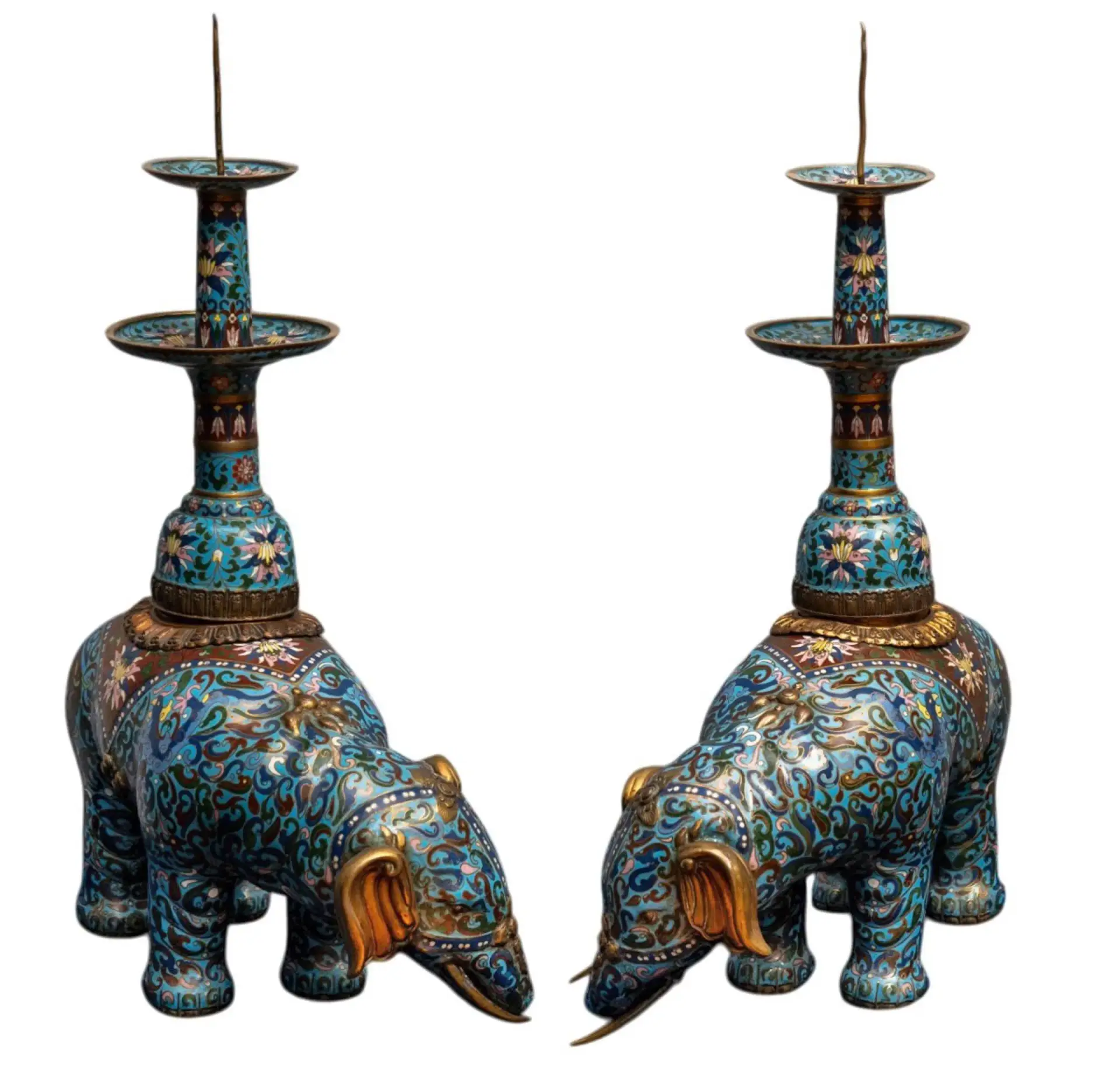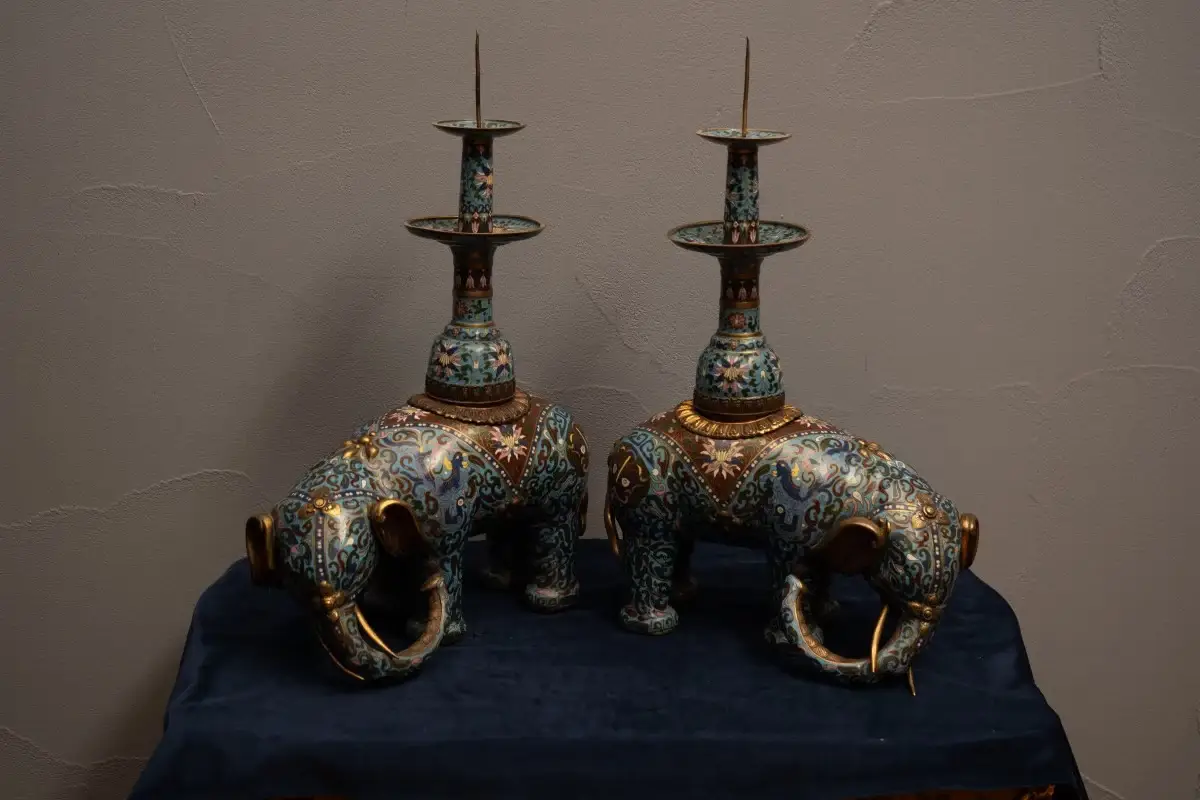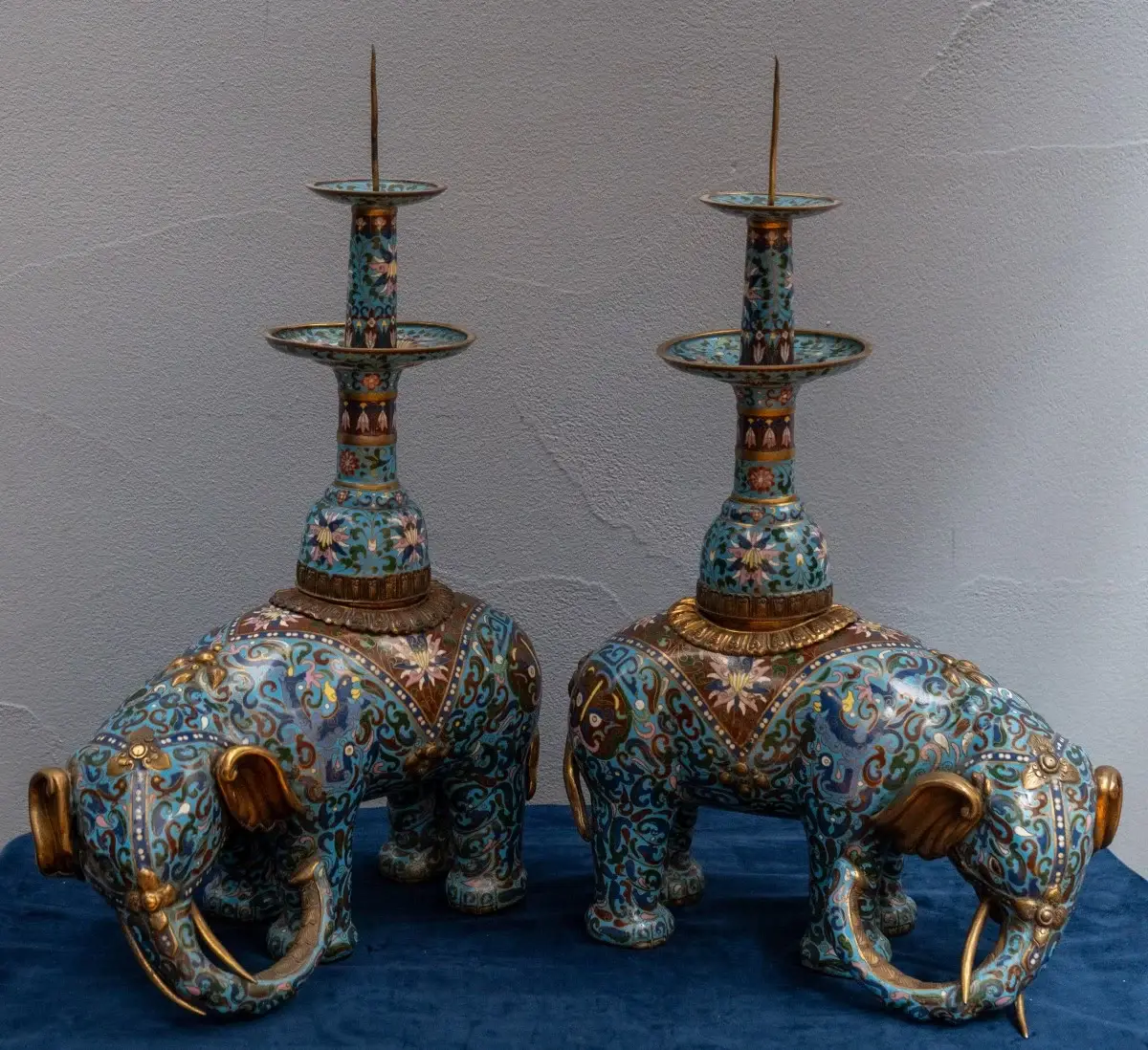
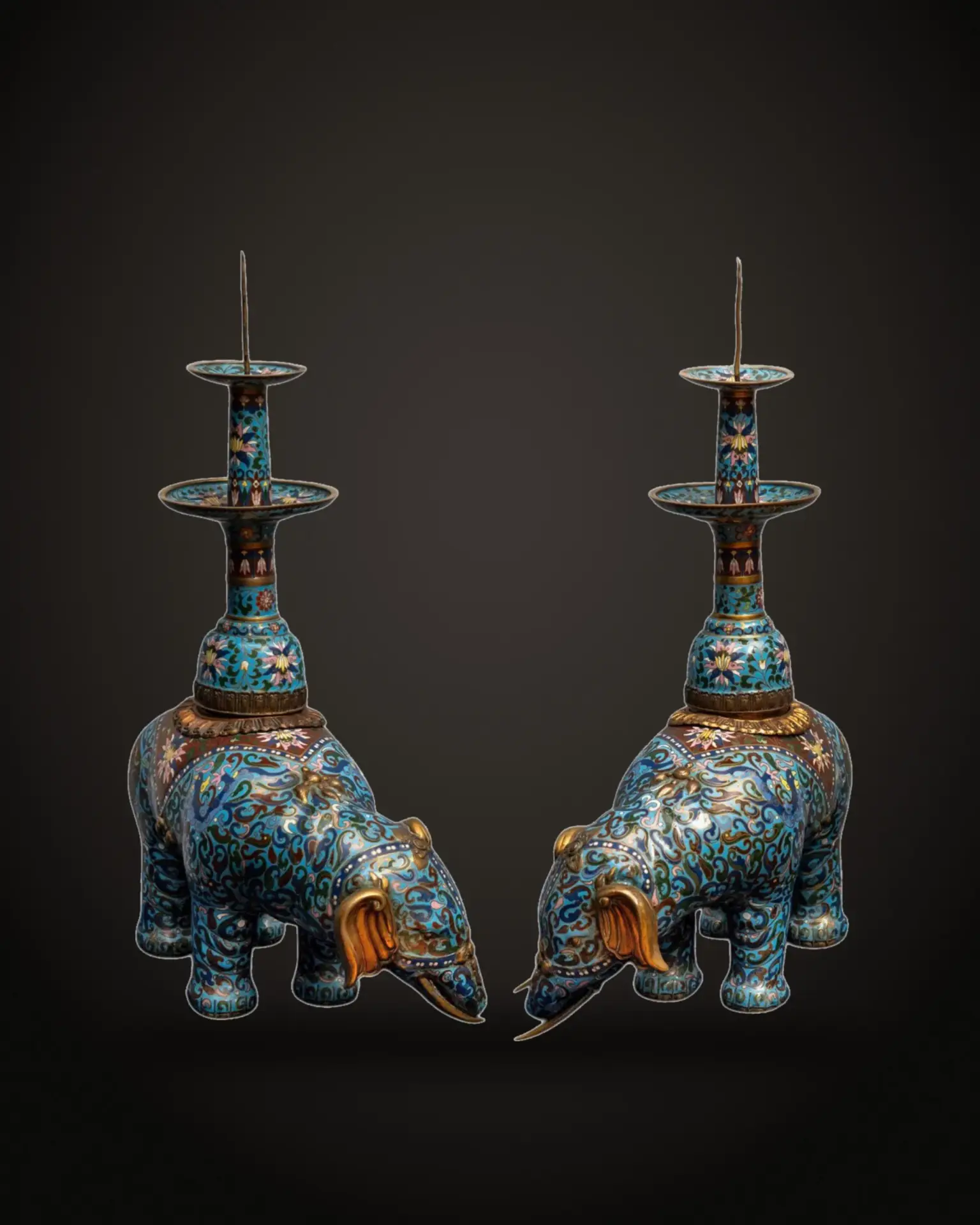
A Pair of Chinese Cloisonné Enamel Elephants, China circa 1880 to 1910
A Pair of Chinese Cloisonné Enamel Elephant-Form Pricket Candlesticks
Late Qing Dynasty, circa 1880 to 1910
Each modelled as a kneeling elephant with trunk curled downward, the body entirely worked in cloisonné enamel on a turquoise ground with dense scrolling lotus and foliate arabesques in polychrome enamels, navy blue, aubergine, sage green, pink, white and yellow, the caparison reserved with lotus medallions on a dark blue ground. Gilt bronze details throughout: cast tusks, chased ear and trunk tips, and a repoussé foliate collar separating the elephant from the removable candlestick shaft above. The tall shaft of waisted form, enamelled en suite with lotus and cloud motifs, issuing two tiered drip-trays and terminating in an iron spike pricket. Shafts original to bases.
The elephant-form pricket candlestick belongs to a well-established tradition of Buddhist altar furniture in China. Such candlesticks typically formed part of a wǔgòng (五供, “five offerings”) altar garniture comprising a central incense burner, a pair of flower vases, and a pair of candlesticks. As noted by Béatrice Quette (Cloisonné: Chinese Enamels from the Yuan, Ming and Qing Dynasties, Yale University Press / Bard Graduate Center, 2011), altar sets were kept in stock in the palace storerooms and assembled into sets when needed, while the wǔgòng comprised a central incense burner with two flanking flower vases and candlesticks, a format that was equally adopted for temple and aristocratic interiors throughout the Qing period. The technique of cloisonné itself, creating designs on metal vessels with coloured glass paste placed within enclosures made of copper or bronze wires, bent or hammered into the desired patterns The Metropolitan Museum of Art, was brought to its most elaborate expression during the 18th and 19th centuries. For comparable examples, see Helmut Brinker & Albert Lutz, Chinese Cloisonné: The Pierre Uldry Collection (New York: Asia Society, 1989).
Condition: One tusk repaired; otherwise intact
Ref. 126325
Dimensions
- Height: 56 cm (22 in)
- Width: 34 cm (13 in)
- Depth: 15 cm (6 in)
Year
19th century
Origin
China